
Polyurea vs Epoxy
The question almost every floor coating buyer asks. Here is the plain-English answer, and why our systems use both.
The Short Answer
Epoxy and polyurea are both good coatings, and they are good at different things. Epoxy bonds deep and builds thickness. Polyurea, including polyaspartic, cures fast, stays flexible and does not yellow in the sun. That is why most quality garage systems, ours included, use an epoxy base with a polyaspartic topcoat.
Side by Side
| Property | Epoxy | Polyurea and polyaspartic |
|---|---|---|
| What it is | A two-part resin and hardener that cures into a hard, rigid layer. | A family of fast-curing coatings. Polyaspartic is a type of polyurea made to be rolled on by hand. |
| Cure speed | Slower. More working time, longer wait before use. | Fast. Pure polyurea sets in seconds and is usually sprayed. Polyaspartic gives a short working time and a quick return to use. |
| Sunlight | Standard epoxy can yellow or amber with UV exposure. | Aliphatic polyurea and polyaspartic are UV-stable and hold their color. |
| Flexibility | Hard and rigid. | More flexible, which helps with impact and temperature swings. |
| Bond and build | Bonds very well to properly ground concrete and builds thickness. | Bonds well too, but its fast cure gives less time to soak into the slab. |
| Best role | Base coat that bonds to the slab and carries the flake. | Topcoat that takes the sun, traffic and chemicals. |
Where "Polyurea Floors" Gets Confusing
Pure polyurea sets so fast it is usually sprayed with special equipment, which is how truck bed liners are made. Most garage floors sold as polyurea use polyaspartic, which is a slower, hand-applied member of the same family. When you compare quotes, ask exactly which products go into each layer.
What Matters More Than the Label
- Surface prep. A coating bonds to what is underneath it. Diamond grinding opens the concrete so the base coat bonds into it. Skipping this step is the most common reason coatings peel.
- Slab condition. Cracks, oil and moisture need attention before any coating goes down.
- A UV-stable topcoat. Anything that sees sunlight, through an open garage door or on a patio, needs a top layer that does not yellow.
What Blackhawk Installs
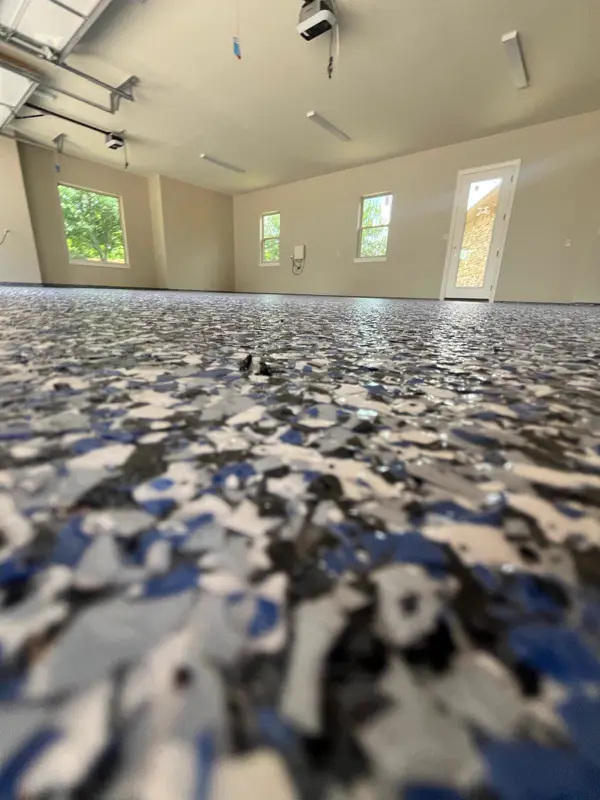
Decorative Flake ($6.00 per sq ft), Stone Flake ($6.50) and Metallic ($10.00) all use a diamond-ground slab, an epoxy base or metallic epoxy coat, and a UV-stable, chemical-resistant polyaspartic topcoat. Grind and Seal ($4.00) is a clear protective sealer over ground concrete with no color coat. See what is in each on the pricing page.
Common Questions
Is polyurea better than epoxy?
Not on its own. Each does a different job well. Epoxy makes a strong base, polyurea and polyaspartic make a tough, UV-stable top. A system that uses both, over a properly ground slab, gets the best of each.
Is polyaspartic the same as polyurea?
Polyaspartic is a type of polyurea. It cures slower than pure polyurea, so it can be rolled on by hand and still return the floor to use quickly.
Why do some epoxy floors turn yellow?
Standard epoxy can yellow when it gets UV light. A UV-stable topcoat on top prevents that.
How long before I can use my floor?
With our systems, light foot traffic after 24 hours and vehicles after 48. Most projects are done in a single day.
Ready for a floor you never have to think about again?
Free on-site estimate. Most floors done in a single day.